
DISPLAY
Stiklestad 1030 – closed to the public
The exhibition "Stiklestad 1030" will be closed to the public from August 26, 2025. A new main exhibition is the main priority in the development project "Stiklestad for a new millennium", and is to be completed by 2030.

The main exhibition Stiklestad 1030 is closed to the public from August 26, 2025.
We are currently working on a new, large main exhibition that will be completed by 2030. A new main exhibition is the main priority in the site-specific museum development project. Stiklestad for the new millennium which is our local initiative on the occasion of the National Jubilee 2030.
Facts about the exhibition “Stiklestad 1030”:
The exhibition opened in 1992, the same year that Stiklestad National Cultural Center was completed.
The exhibition in the brick corridor was designed as a walk through events related to the battle of Stiklestad on July 29, 1030. Through scenes and tableaux, the background and consequences of the battle were shown.
The exhibition has remained virtually unchanged since 1992, but some objects have been replaced and more extensive text posters in Norwegian and English have been added over the years.
The exhibition was created by:
Architect Jens P.Askim and Lars F. Stenvik, Science Museum.
Textile workers: May Bente Aronsen and Kjersti Svendsen
Model carpentry: Jarle Vangstad
Original music: Henning Sommero
The original objects in the exhibition Stiklestad 1030 were on loan from the Science Museum. They have now been returned to the Science Museum for conservation.
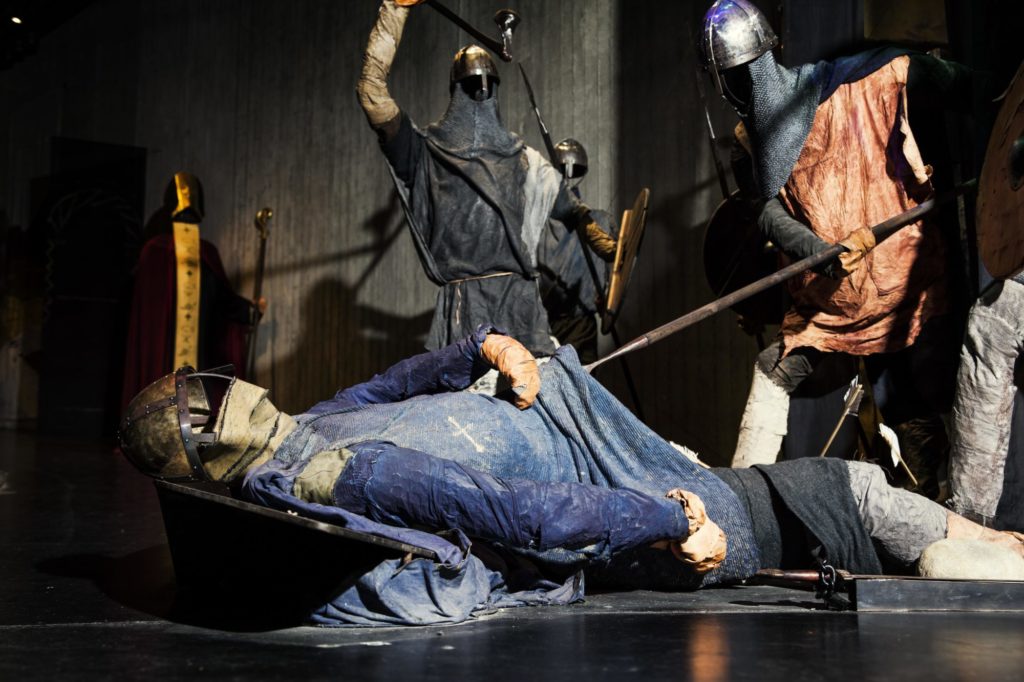
On July 29, 1030, the most famous battle in Norwegian history took place at Stiklestad. Here the Viking king Olav Haraldsson fell, while the story of the martyr king Olav the Saint began.
The legacy from Olav has influenced Norwegian society for almost a thousand years. The exhibition "Stiklestad 1030" is a journey through both Olav's time and the great shift from Norse religion to Christianity. What did the change of faith really mean? Why did they rebel against Olav? What consequences did the king's fall at Stiklestad have? Text, pictures, tableaus and, not least, original objects from Olav's own time allow you to get close to a society at a turning point and Stiklestad's core history.
Welcome to "Stiklestad 1030"